

• Home
  • Stories
  • Team
  • Archive
  • Contact
Menu

The PhDISH

PhD Insights into Science and Health
  • Home
  • Stories
  • Team
  • Archive
  • Contact

The Bots Next Door

by Guest User
 on November 19, 2014
The average neighbors' homes.

The average neighbors' homes.

When you buy "green" appliances, how do you really know you're really saving energy (and money)? One way to figure this out would be to use your monthly energy bill as an indicator. But from month to month, your energy usage patterns change, the weather most certainly changes, you may have gone on vacation one month, etc etc etc...so many variables you can't control.

Fear not young scientist, the Tennessee Valley Authority (TVA) has you covered. From 2009 to 2012, the TVA built 3 identical homes to test this very idea. One home was built to local building requirements and served as a control. The second was retrofitted to have some energy efficient improvements that an average consumer would easily be able to buy, e.g. Energy Star applicances. The third was a "High Performance Home" with solar panels, solar water heating, Energy Star appliances, properly insulated windows, etc.

The TVA didn't stop there. To mimic human activity in each house, every appliance or utility was used at a regular schedule over the course of the experiment. Refrigerator doors opened and closed at preset times (see image right). The TVs turned on to no one watching. The showers sprayed empty tubs. Going one step further, the TVA included "Human Body Emulation Systems" (see image left) which generated ambient heat and humidity similar to what an average human family would output. Containers of water filled the fridges to simulate the humidity and thermal properties of food.
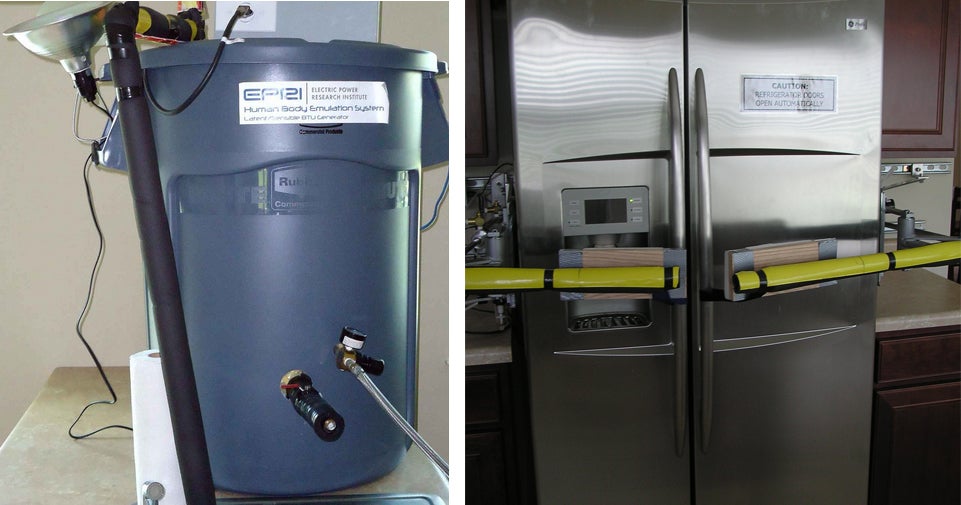
Left: "Human Body Emulation System." Right: Robot refrigerator door openers.

Left: "Human Body Emulation System." Right: Robot refrigerator door openers.

Results showed, unsurprisingly, that the High Performance Home consumed less energy than the Retrofitted home. And both beat the average home built to local laws. More importantly, we see a prime example of how to use controls in a large-scale experiment (I'M LOOKING AT YOU MYTHBUSTERS). via Gizmodo, Popular Science, and the TVA.

Tags Cool-Ish
← Manuscript Accepted! Title: "Get me off Your F*cking Mailing List"The Antares Rocket was Remote Detonated →
No results found

Recommended

Featured
New study sheds light on why the effectiveness of placebos is getting stronger
January 6, 2016
Michael Schreiber
New study sheds light on why the effectiveness of placebos is getting stronger
January 6, 2016
Michael Schreiber

While the strength of the placebo effect has been steady in the rest of the world, its magnitude has steadily strengthened in the United States.


Read more →
January 6, 2016
Michael Schreiber
Above the fruited plain: GMOs in perspective
July 27, 2015
Deepti Mathur
Above the fruited plain: GMOs in perspective
July 27, 2015
Deepti Mathur

In this post, Deepti Mathur and Amy Jobe tackle the nuances of the GMO debate.

Read more →
July 27, 2015
Deepti Mathur
Featured
What's the Dish on Global Warming?
August 23, 2014
Deepti Mathur
What's the Dish on Global Warming?
August 23, 2014
Deepti Mathur

We’ve all heard about the disappearing polar ice caps, rising sea levels, and emerging crazy weather patterns around us. But discovering these environmental changes didn’t happen overnight – lots of careful research goes into the field of climate science, and there’s more work being done every day to explore details about phenomena triggered by global warming. July has been particularly abuzz with articles in this field; below, I’ve summarized a few of the papers and news items from the summer.

Read more →
August 23, 2014
Deepti Mathur

Latest

Featured
Understanding ‘understanding’: What We Understand is Influenced by How We Understand
Siddhant Iyer
Understanding ‘understanding’: What We Understand is Influenced by How We Understand
Siddhant Iyer

The history of science is full of examples of discovery, both intentional and accidental. But how do scientists study subject matter incapable of being explained by simple models? And additionally, if science can produce favorable results (say, in the clinic), to what extent does it matter whether or not the results can be fully explained? Here, Siddhant Iyer outlines the ways in which scientists may study as-of-yet unexplained phenomena and argues for a framework involving the use of complex models while also acknowledging limitations.

Read more →
Siddhant Iyer
The Mysteries of REM Sleep
Xinyue Chen
The Mysteries of REM Sleep
Xinyue Chen

REM sleep is widely known to be essential for mood, memory, and learning. But why is it needed in the first place? Here, Xinyue Chen details her own experiences with sleep deprivation and discusses the four key features of REM sleep in humans, explaining how a full understanding of such a critical and well known biological process remains elusive.

Read more →
Xinyue Chen
Healthcare in the Metaverse
Khushbu Kabra
Healthcare in the Metaverse
Khushbu Kabra

The metaverse is a concept not typically associated with the healthcare industry. However, healthcare companies are quickly beginning to invest in this technology, promising virtual hospitals and pharmacies among other benefits in the not-too-distant future. Here, Khushbu Kabra discuses the potential role the metaverse will play in future healthcare, as well as the current state of the technology and concerns that will need to be addressed.

Read more →
Khushbu Kabra
Animal-Assisted Interventions
Alec Kittredge
Animal-Assisted Interventions
Alec Kittredge

Exposure to dogs and other animals can help to reduce stress and improve patient outcomes in hospital settings. Here, dog-owner Alec Kittredge explains how animal-assisted interventions have been used and studied for the past several decades.

Read more →
Alec Kittredge

Contributors

  • Adrien Stanley (2)
  • Alec Kittredge (4)
  • Amy Jobe (8)
  • Andres Villegas (1)
  • Ashlea Morgan (1)
  • Ben Sally (2)
  • Daniel Duzdevich (1)
  • Darshini Mahadevia (1)
  • David Kazadi (2)
  • Deepti Mathur (11)
  • Elizabeth Stivison (2)
  • Ethan McCurdy (3)
  • Franklin Garcia (1)
  • Grace Herod (2)
  • Guest User (8)
  • Ishani Ganguly (1)
  • James Lohner (5)
  • Jordan Kesner (1)
  • Karin Isaev (1)
  • Kathryn Birkenbach (1)
  • Khushbu Kabra (2)
  • Lara Boyle (4)
  • Ling Ye (1)
  • Max Cabaj (1)
  • Michael Schreiber (14)
  • Nicholas Giangreco (2)
  • Nick Bulthuis (1)
  • Paige Helmer (2)
  • Patricia Cooney (1)
  • Sarah Kleinstein (1)
  • Sarah Puhr (3)
  • Sergej Borowik (1)
  • Seth Robey (3)
  • Siddhant Iyer (1)
  • Tim Bonvallet (1)
  • Victoria Allen (1)
  • Xinyue Chen (2)
  • Xinyue Chen and Claire Everett (1)

© 2021 PhDish. All Rights Reserved.